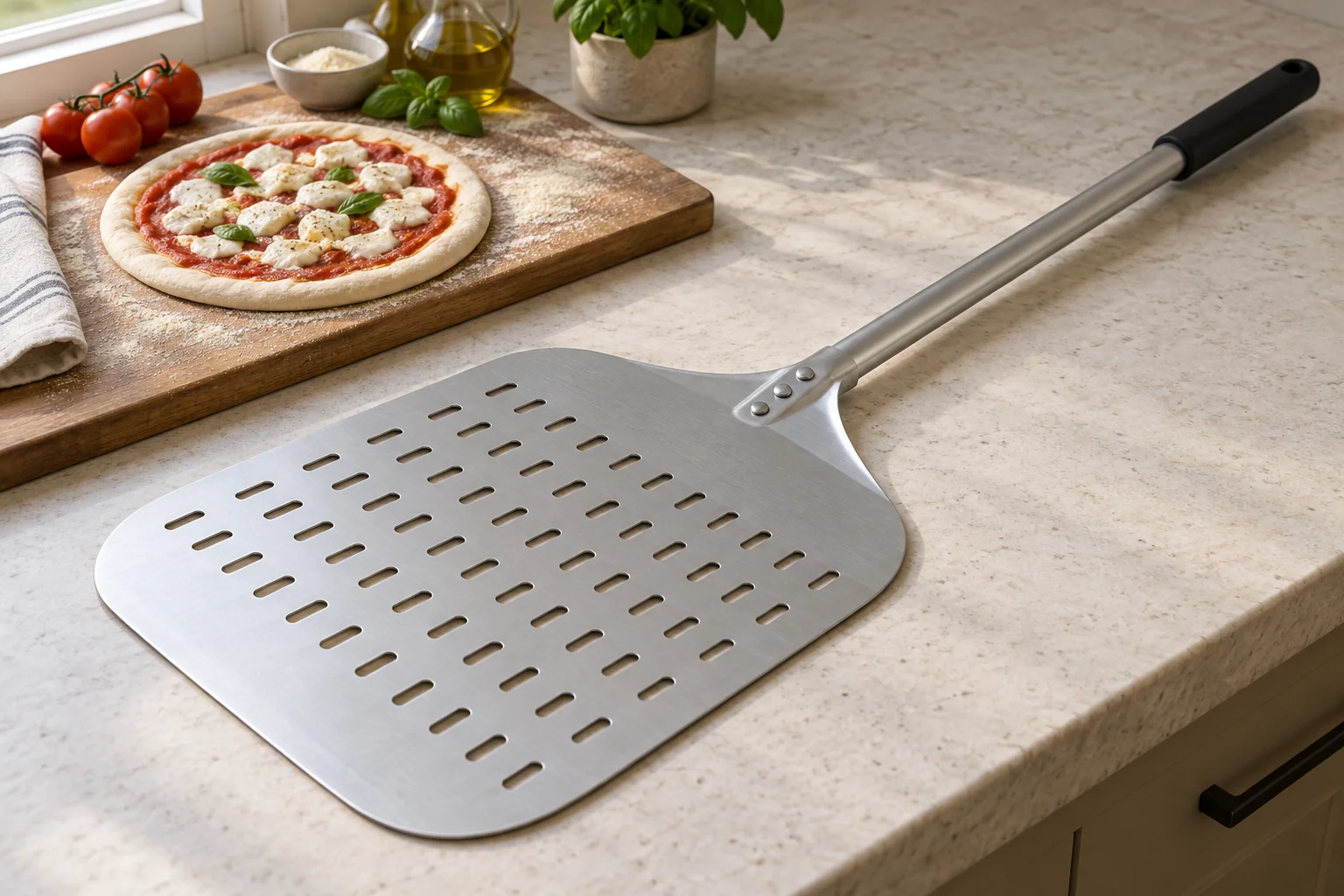
Loose flour can fall through
Openings in the metal blade let loose flour or semolina fall away. Less of it then travels with the pizza onto the hot baking surface. This is particularly useful when the dough was generously dusted during shaping. Perforations do not replace sensible dusting, however, and cannot remove sauce that has already worked between the dough and peel.
Before launching, use a small level movement over the work surface to check that the pizza slides freely. Vigorous shaking or steep tilting can shift the toppings. Excess flour should remain on the work surface rather than being deliberately shaken into the hot oven.
Match the size and shape to the oven
The blade needs enough area to support your unbaked pizza while still fitting through the oven opening. Measure both, including any necessary clearance at the sides. Choosing the largest possible peel is no improvement if it strikes the frame on every launch. Handle length also needs to suit the oven depth and the space in front of it.
Do not confuse a broad launching peel with a small round turning peel. The latter is primarily for moving a pizza whose base has already started to set inside the oven. It does not support a large raw base in the same way. Whether you need one tool or two therefore depends on your oven and routine.
Prepare the dough and peel for launching
The surface should be clean, dry and not already hot when it picks up raw dough. A peel that has just spent a long time in the oven is therefore not immediately an ideal preparation surface again. Follow the material and manufacturer’s guidance for cooling and cleaning; do not improvise by cooling a hot tool with water.
Shape the dough evenly, check for holes and use a moderate amount of topping. Drain wet ingredients appropriately. Avoid leaving a topped pizza waiting on the peel for a long time. If it sticks, address the cause at the work surface instead of trying to force it into the oven with a violent movement.
Cleaning and the limits of perforations
Once the tool is cool, remove residue around the openings too. Its care instructions determine whether dishwashing or abrasive cleaners are allowed. Ooni specifies handwashing for its perforated aluminium peel, for example, and warns against prolonged exposure to high temperatures. That is a particular manufacturer’s instruction, not permission to treat every metal peel alike.
Perforations do not automatically make sticky dough manageable or guarantee a crisp pizza. If you already launch reliably with your existing peel, replacing it is not essential. A perforated version becomes interesting mainly when you want to reduce flour carry-over and its blade size, material and handling fit your setup.