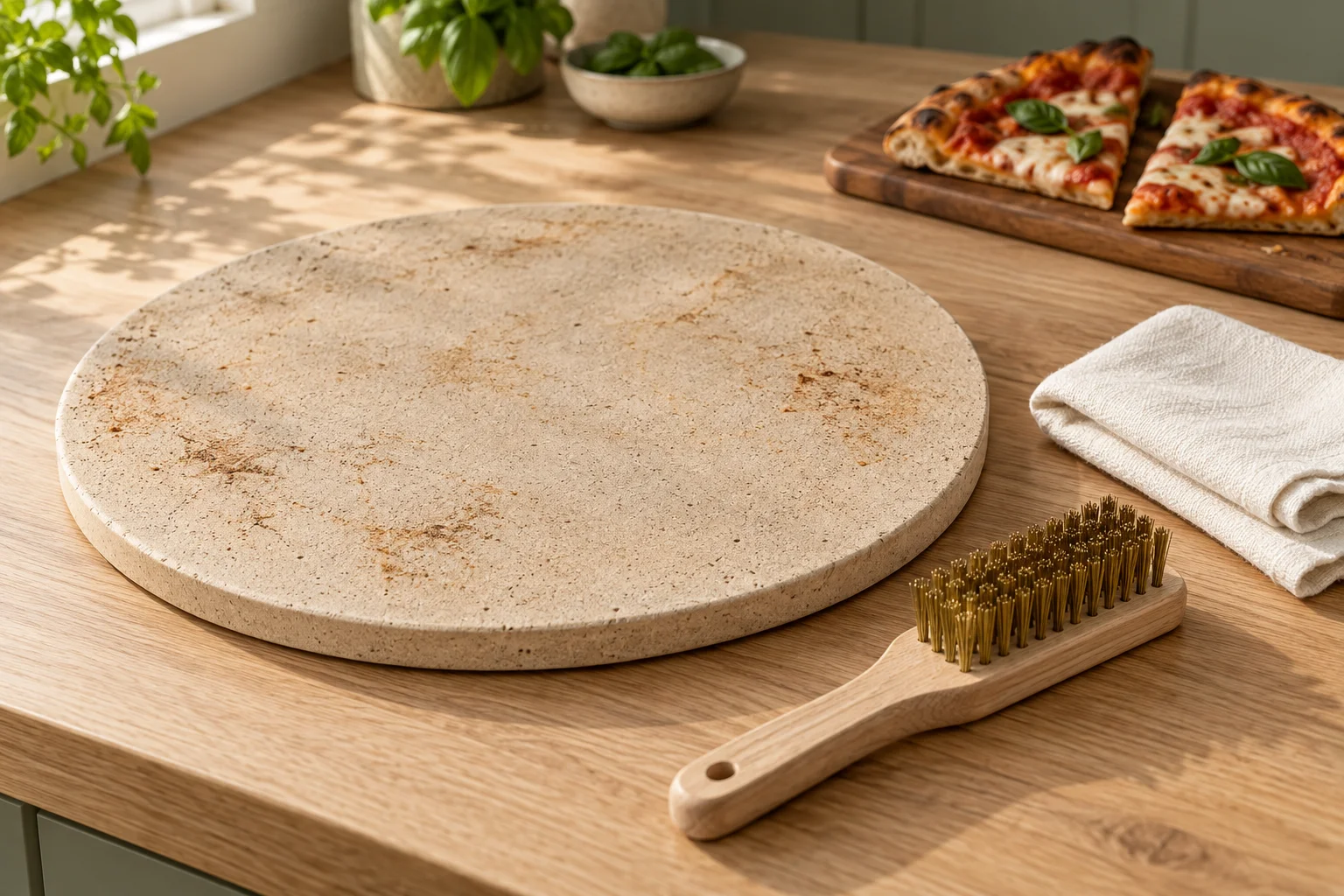
Identify the material first
Products sold as pizza stones are not all the same. They include porous cordierite slabs, fireclay stones and coated or glazed baking surfaces. They do not automatically tolerate the same cleaning. Start with the instructions for your particular stone or oven. Advice for a removable baking stone cannot simply be transferred to a permanently installed oven floor, just as cast iron care is not stone care. Instructions differ especially where water and cleaning products are concerned. If the packaging is missing, use the exact model name to find the manufacturer's manual.
Ooni and Alfa provide a clear example of that difference. For the Volt 2 stone, Ooni prohibits water, soap and chemical cleaners. Alfa describes using a damp cloth on its own refractory floors. That does not establish that every stone can be washed, or that every damp cleaning method is wrong. Apply the permission only to the product it covers. A dark mark is not a reason to experiment beyond that limit. Advice involving baking soda paste, vinegar or a dishwasher also needs to match the manufacturer's instructions.
Let the oven cool completely
Plan the main cleaning after the equipment has cooled. A stone stores heat for a long time, and an extinguished flame or switched-off display does not establish that you can touch it. Follow the appliance shutdown instructions. Electric models may need a cooling period with the fan running before you turn off the main switch and unplug them. For the Volt 2, the prescribed standby period before disconnection does not mean the stone is fully cold. Keep the area clear so nobody reaches the hot surface without realising it.
Do not cool the stone with water, ice, a wet cloth or by putting it on a cold, damp surface. Large local temperature differences can create stress. Let it cool undisturbed in the intended appliance, removing it only when it is in a suitable condition to handle. Use both hands and support the slab rather than pulling on one corner. Prepare a clean, level, dry resting place first. Handling a heavy stone above a full sink makes the job unnecessarily awkward. Clear enough space before you begin to lift it.
Remove loose residue gently
Start with what comes away without vigorous scrubbing. Remove crumbs, burnt dusting flour and dry topping residue with the brush or suitable scraper specified for the stone. Keep a scraping edge shallow and work gently so you do not gouge channels into the baking surface. A sharp kitchen knife or an aggressive metal scouring pad is a poor substitute. Check the tool itself as well. A damaged brush with loose bristles does not belong on a surface that will hold food. Remove the loosened particles completely.
The edges of removable slabs are often easier to reach on your prepared work surface. Still follow the specified removal direction, particularly when the stone passes sensors, heating parts or retaining fittings. A rotating stone may have several sections and a particular installation position. Do not treat it as any ordinary single-piece slab. Stubborn residue may take patience. Pressing hard against a thin edge increases the chance of breakage. If the manufacturer specifies a final wipe with a dry cloth, use a clean, lint-free one rather than a damp paper towel.
Distinguish stains from deposits
After many baking sessions, a stone may have brown or black areas even when no thick layer remains on top. Such discolouration is normal wear on many unglazed stones. Restoring the original pale colour is not a reliable cleaning target. Raised, sticky or loose deposits are different. They can attach to the next pizza, smoke or leave an unpleasant taste. Examine the surface in good light, distinguishing a flat mark within the material from a crust sitting above it. The stone must be completely cold before you check it by touch.
Do not try to grind away every dark patch with increasingly harsh tools. You can turn a cosmetic mark into damage. Conversely, a stone that looks smooth is not automatically suitable for use if it has been exposed to inappropriate cleaners, unknown liquids or mould. Baking heat does not universally undo that history. Stop using a stone with unexplained contamination and ask the manufacturer whether reuse is possible. If that remains unresolved, a compatible replacement makes more sense than a series of improvised cleaning attempts. Colour alone cannot settle the question either way.
Use a cleaning heat cycle only as specified
Some manufacturers specify a heating cycle to break down food residue, followed by brushing after complete cooling. Use the settings, duration, positioning and preparation given for the particular appliance. That does not translate into a general recommendation to heat every stone for as long as possible at maximum power. A household oven's automatic pyrolytic cleaning programme is not blanket approval for a pizza stone left inside. Check separately that both the oven and the stone permit that use. If they do not, remove the cold stone before running the oven's cleaning programme.
Large accumulations of grease do not belong in an improvised extra-hot cleaning attempt. Remove excess residue as the appliance instructions require before starting an approved heating cycle. Supervise the process and keep the necessary ventilation paths clear. If the manufacturer allows the slab to be turned over, do so only when it is fully cold and in the intended installation position. Putting the dirty face underneath does not solve cracks, moisture or unexplained contamination. Allow complete cooling after the cycle, then remove the remaining loose residue and inspect the surface again.
Take moisture seriously
Water is not part of routine care for a stone that must expressly stay dry. If it becomes wet accidentally, do not immediately heat it hard to hurry things along. Porous material can absorb moisture that is no longer visible on the surface. Feeling dry to the touch does not establish that the inside of the slab is dry as well. Follow the manufacturer's advice on what to do next. Some products have specific instructions after accidental water contact; for others, you need to clarify whether and how they can be used again.
When damp cleaning is permitted for your product, use only the specified amount of water and method, then allow for the required drying. Permission to wipe does not automatically include a long soak. A fixed number of hours will not suit every thickness, porosity and room humidity. Position the stone for drying as the manufacturer directs, with adequate air and no trapped moisture. Do not wrap it in plastic or put it into a close-fitting cover while still damp. A drying heat programme is an option only when described for that particular product.
Check cracks and damaged edges
After cleaning, inspect both faces and the edges wherever you can reach them without dismantling the oven. Through-cracks, loose pieces or an unstable slab are reasons to stop using it. Even a small defect can matter differently at a supporting edge than a superficial mark in the middle of a substantial surface. Do not judge usability solely by the visible length of a line. The particular manufacturer's instructions determine whether damage requires replacement. Ooni says not to use a broken stone in the Volt 2.
Do not glue broken sections together with household adhesive or grind damaged edges to make them fit. The slab combines food contact, high temperatures and mechanical loading. A replacement must match the model, supports, dimensions and intended thickness. A random tile or unknown building material is not an equivalent substitute. When ordering, check whether your oven uses a one-piece or multi-piece floor. Keep the model details with the care instructions so you do not have to select a future replacement using only an approximate diameter or a photograph of the old stone.
Store it dry and protected against breakage
Keep the fully cold, dry stone somewhere it cannot fall or knock against hard edges. A flat surface with sufficient support is often simpler than leaning it loosely between heavy pots. If upright storage is intended, the slab needs a secure holder. Do not place objects on it that create concentrated loads or could pull it down accidentally. A suitable dry protective cover can help during transport, but does not replace a stable storage position. Before packing it away, check that its underside and edges are also free from moisture and crumbs.
For outdoor appliances, establish whether the stone should stay in the oven and how to protect the whole appliance from damp conditions. A cover does not automatically make a damp location dry. Inspect the stone after a long break before heating it again. In a household oven, leaving a stone inside can change preheating and the way other dishes bake. It must not block airflow and needs removal before cleaning programmes for which it is not approved. Keeping the brush and instructions with the accessories saves searching for them at the next clean-up.
Leave less residue next time
The most useful prevention begins before launching the pizza. Use only the dusting flour you need to move the dough safely, and remove excess at the preparation area. A thick layer of flour on the stone does not provide a lasting improvement in sliding. It can burn and attach to the next pizza's base. Check the stretched dough for holes and keep sauce and cheese from spilling beyond the edge. Release sticky patches at the work surface, before the pizza reaches the hot baking surface. This is easier than dealing with escaped toppings inside the oven.
Prepare moist ingredients as the recipe requires, for example draining mozzarella and leaving released cooking liquid behind when adding cooked vegetables. Overloading a pizza is an awkward way to provide extra food for hungry guests. If toppings do land on the stone, follow the appliance instructions for anything done while it is hot. Do not improvise with a wet cloth. After baking, the routine can often stay simple: let everything cool, remove loose residue gently and inspect the surface. The marks of use can remain when the material is intact and the surface is properly cleaned.