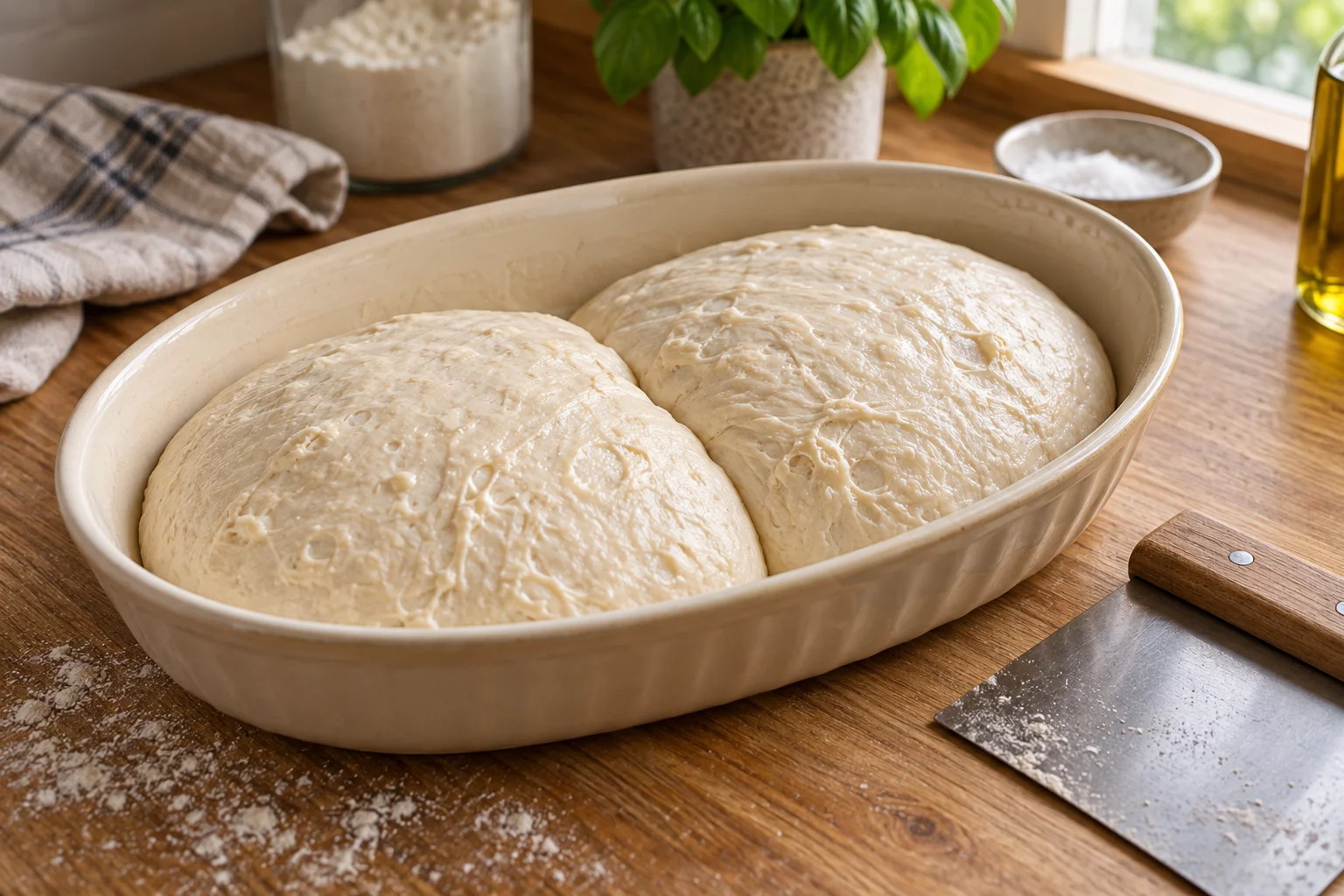
Recognise overproofing through behaviour, not just the clock
Overproofed pizza dough has moved beyond the useful handling stage for its particular formula. It may spread excessively, tear unusually easily when lifted or lose height that it previously gained. Large bubbles and a very soft feel are not enough to establish that diagnosis on their own. Deliberately high-hydration dough looks different from a firm dough with less water, and warmth also makes dough softer. Compare its current behaviour with the intended method and consider whether the structure has become noticeably weaker since the previous check.
Look at several clues together when assessing a portion in its box. Did it first gain volume and then collapse? Can an edge still be lifted as one connected piece? Does a stable centre remain when you gently open it? An oversized, slack ball whose surface collapses under light contact suggests excessive proof more strongly than an evenly relaxed portion. Overproofing describes a baking problem. Whether the dough should still be used as food requires a separate assessment of its ingredients and known storage history.
Establish which dough you are assessing
The adjustments below concern a simple wheat pizza dough made with flour, water, salt and yeast, possibly with a little oil. Filled dough, an already topped base or a mixture containing eggs and milk needs a different assessment of its storage. Do not transfer advice about dough structure to every kind of prepared food. Establish when it was mixed, how long it stood warm and whether it was refrigerated. If that history is unknown, a successful shaping check cannot retrospectively establish safety.
Discard the entire affected dough if you see mould. Do not simply cut out the visible patch or try to correct it through baking. Unusual discolouration or a clearly abnormal spoilage smell is also a reason not to continue using it. A yeasty or mildly alcoholic smell can occur during fermentation, but it proves neither spoilage nor safety on its own. Do not taste raw dough as a safety check. Only consider whether the ball can still be shaped after deciding whether using it is appropriate at all.
Read touch, volume and extensibility together
A gentle pressure check can add to what you see. Lightly flour a finger and press carefully into the surface. Dough that springs back very quickly and feels dense may still need relaxation or fermentation. An indentation that remains is not, by itself, conclusive evidence of overproofing. Temperature, hydration and flour all affect the response. If the entire portion collapses under slight pressure and its surface barely holds together, the signs of weakened structure become more significant.
Avoid repeatedly poking deeply into every portion. The aim is to assess their condition rather than damage them further. Start with one ball as a reference and observe the others from outside. A straight-sided container or a photograph from the beginning of proofing helps you compare volume. In a wide bowl, dough can grow sideways without gaining much height. Its low shape at one moment therefore does not reliably show that it has collapsed. The sequence of changes is more useful than an isolated impression.
Change as little as possible while the dough still holds
If the dough is very mature but remains cohesive, baking it promptly may be the simplest option. Prepare the oven, baking surface and toppings completely first. Lift one portion gently with a scraper and open it slightly smaller than originally intended. Preserve a stable centre and avoid letting it hang over your hands for a long time. Add a light, well-drained topping. A smaller diameter reduces the stretching needed, but the resulting slightly thicker centre still requires appropriate baking time.
Check that the dough slides on the peel before adding sauce. Very soft dough becomes difficult to correct after topping. If a free transfer is unreliable, use a suitable lightly oiled metal pan or tray. That support can make handling easier without restoring the original dough structure. You may get less rim volume or a less regular outline. A smaller pan pizza can be a useful result; there is no need to force an already fragile portion into the same large circle as the original plan.
Re-balling has limited uses
With a slightly overproofed yeasted dough that still has sufficient strength, one gentle fold and re-ball may make the portion easier to handle. Release it cleanly from the box, fold the edges towards the centre and close the seam. Use only a few movements and just enough flour to prevent sticking. Some gas escapes in the process. The ball then needs another covered rest before it can be opened comfortably. This changes the baking schedule: rolling a freshly tightened ball immediately is usually difficult.
There is no reliable universal waiting time because temperature, yeast quantity and previous fermentation vary considerably. Check early and regularly. If the dough quickly spreads again after shaping or tears into soft strands during folding, further re-balling is unlikely to help much. It does not reset the biological fermentation process. Strongly weakened sourdough is particularly unreliable to recover this way; its long fermentation and acid development may have changed handling further. Avoid repeating the process indefinitely in the hope of starting the dough's development again from zero.
A pan can support fragile dough during baking
A smaller tray pizza is often easier to handle when the dough is still suitable to use but difficult to shape freely. Lightly oil an appropriate metal pan and transfer the dough with a scraper. Spread it gently using lightly oiled fingertips. If it contracts, cover it briefly and allow it to relax. If it flows without resistance, there is no need to add a long extra proof simply because another pan-pizza recipe includes one. You are handling an existing mature portion rather than beginning a new complete formula.
Keep the dough layer manageable and the topping light. A deep mound beneath a large quantity of sauce makes cooking the centre more difficult. Choose the temperature and baking setup to suit the pan and an appropriate tray method. Inspect the underside and middle before removing the pizza. This approach can make delicate dough usable, but it does not promise especially airy focaccia. A long-fermented dough with weakened structure does not become a newly planned focaccia dough with predictable height and baking time merely by changing the container.
Refrigeration, flour and extra yeast address different things
Cooling slows further fermentation and can temporarily make handling feel firmer. It does not restore structure that has already been lost. A large warm dough mass also does not become cold throughout immediately on entering the refrigerator. If you want to slow the proof, plan cooling early enough in the schedule. A visibly collapsed dough will not automatically become ready again after a night in the fridge. Assess its condition after cooling rather than relying only on the fact that it now feels less sticky.
Adding a substantial quantity of flour changes the whole formula. Water, salt and yeast then have different proportions relative to the flour, and the newly added flour needs time to hydrate. The result can be dry and uneven without solving the original problem. Kneading in extra yeast is likewise not a general remedy for weakened structure. More gas production has limited value when the dough cannot retain that gas well. Distinguish a sticky contact surface, which a little dusting may help, from a fundamental change to the dough's composition.
For example, a batch containing 500 g flour and 325 g water has 65 percent hydration. Kneading in another 100 g flour leaves the same 325 g water against a new total of 600 g flour, reducing hydration to about 54.2 percent. The dough may feel firmer, but its previous fermentation has not disappeared. A firmer consistency after that addition therefore does not demonstrate that overproofing has been reversed.
Identify the likely cause before the next batch
Start with the actual temperature. The same dough can develop much sooner in a warm summer kitchen than in a cool room. Warm water and extended machine kneading also affect its starting temperature. Where possible, record the dough temperature after mixing and the room temperature during the warm proof. Use a suitable clean probe inside the dough when you need an internal reading. A surface reading or a judgement made by touch offers only limited guidance about the centre.
Next, check the yeast type, quantity and schedule. Fresh yeast, instant yeast and active dry yeast are not interchangeable in equal weights. Confusing them can substantially change the timing. With small quantities, consider whether your scales can measure them reliably. Use a complete recipe designed for the time available and the planned refrigeration. Extending the warm period may require a change in yeast quantity or temperature. Assuming that a longer fermentation is always better can easily carry an otherwise suitable dough beyond its useful baking window.
Plan a realistic window for several pizzas
The final pizza of an evening waits longer than the first. If all the balls are brought into warmth early, followed by oven setup, topping preparation and conversation, some portions may move past their best handling stage. Prepare the work area in time and plan the order of the pizzas. With a suitable refrigerated method, you can bring portions out at staggered times instead of placing them all on the counter together. The appropriate interval depends on the dough and on how quickly the pizzas are actually being baked.
After baking, briefly note which portions remained stable and when the difficulties began. A photograph of the box, a temperature reading and the time of dividing are often more helpful than a long list of general guesses. Change one significant factor in the next batch and begin observing earlier. This makes the cause easier to identify than changing flour, water, yeast and every rest period simultaneously. The aim is dough that handles well throughout your actual baking session, with enough time to prepare each pizza calmly.