Decide on the sequence before choosing the box
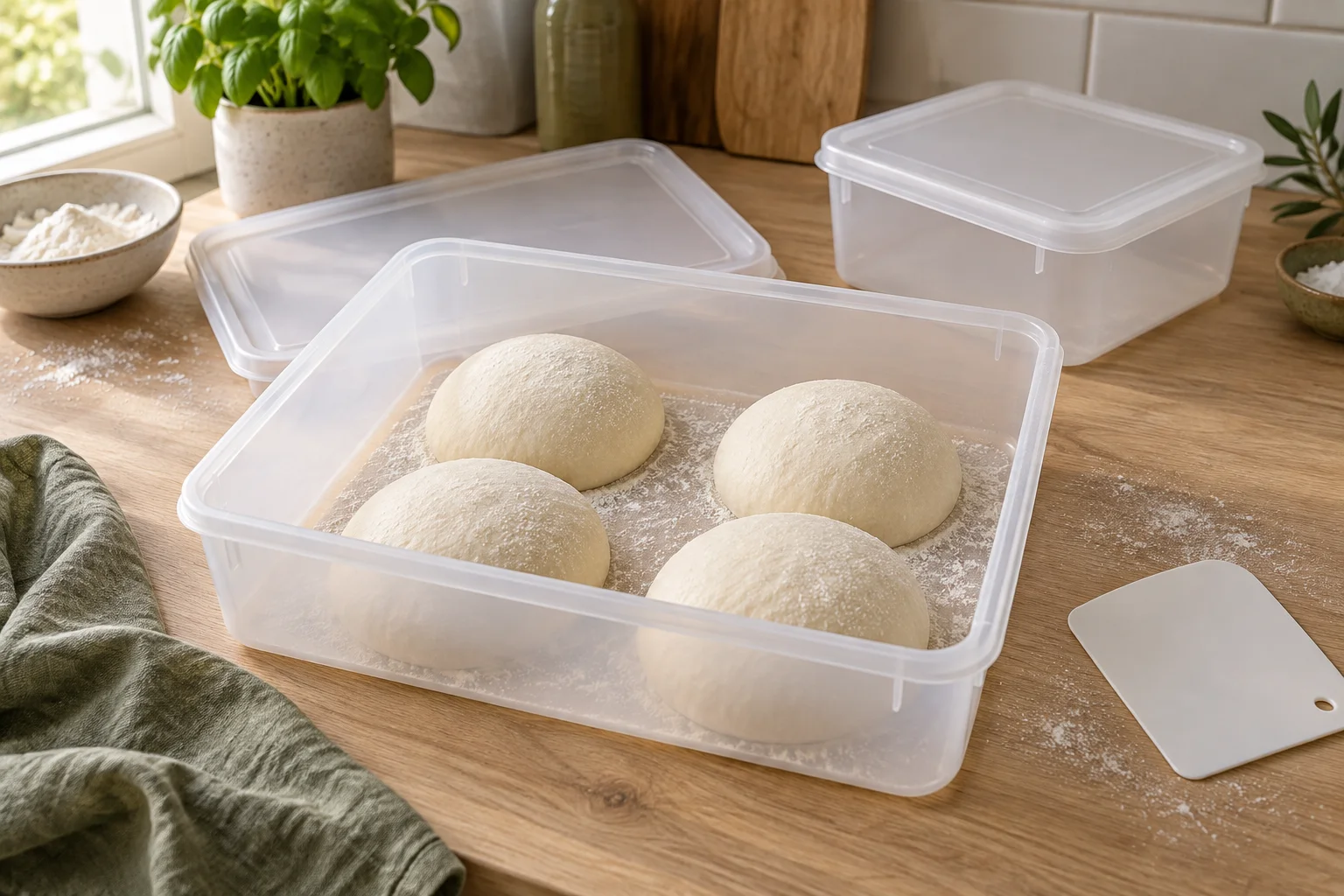
First consider where the container belongs in your recipe. During bulk fermentation, the whole dough rests together. A sufficiently large vessel with an easily visible filling level can be useful here. During final proofing, shaped dough balls sit alongside one another or in separate containers. Base area and the ability to remove each ball gently become particularly important. A tall narrow container may suit the complete dough batch but work poorly for four shaped balls. A wide shallow box can accommodate several portions even when its height would be unsuitable for a large single mass of dough rising inside it.
Note how many pizzas you normally bake, the recipe weight of each dough ball and whether proofing takes place in the refrigerator or at room temperature. These details need to work together. A box does not replace an appropriate fermentation plan or automatically make dough intended for tonight suitable for several days of storage. Clean containers you already own can do the job if they are suitable for the intended food contact and have appropriate lids. A dedicated pizza box earns its place when its shape makes stacking, removal or transport easier. An existing suitable container provides a useful starting point for adding only the size you actually lack.
Check the internal base, height and refrigerator fit
Outside dimensions determine whether the box passes through the refrigerator opening and fits on the intended shelf. Include handles, overhanging lids and side catches. For stacking, measure the total height with the lid fitted, rather than the tub alone. Tapered walls and rounded corners can leave considerably less usable space than the outside width suggests. For dough balls, seek the actual internal base dimensions. Also allow for the hand or scraper that needs to approach from the side and slide underneath a portion. A container into which the balls can only just be squeezed is not yet a comfortably usable size.
The portions grow during proofing and may spread sideways. Allow room between them and below the lid; a freshly shaped ball is not its final size. Manufacturer portion counts apply to the stated dough weight and provide guidance for that particular product. Ooni, for example, describes its pizza box as holding up to six 250-gram dough balls. That does not mean every similar-looking box holds six portions of any size. Larger, softer or more developed dough balls may call for fewer in a box. Bulk dough also needs sufficient space above its starting volume so it can grow without pressing against the lid.
A shared box or individual containers
A larger shared box can be moved in one operation and often means fewer separate lids. It is straightforward when every dough ball follows the same schedule and will be baked in sequence. Removing one portion should disturb its neighbours as little as possible. When balls grow tightly together, separating them can release gas and disrupt their shape. Smooth accessible walls make the task easier. With a deep box in particular, check whether your existing scraper can slide flat underneath the dough. More litres do not solve that access problem by themselves. Container shape matters at least as much as its stated volume.
Individual containers let you take only the dough balls you currently need out of the refrigerator. They can help when recipes or baking times differ and prevent neighbouring portions from growing together. The trade-off is more opening, washing and storage work. Round containers also use a rectangular refrigerator shelf differently from rectangular ones. Existing individual tubs may suit a household making two pizzas, while a shared shallow box may be more convenient for several identical rounds. Choose according to the real sequence. Different ingredients or allergy requirements still call for appropriately separated preparation and clear identification, regardless of the shape of the container holding each portion.
What the lid needs to do
The lid should protect the surface from drying. A firm skin makes stretching harder and can tear during shaping. A thin porous towel does not retain moisture as reliably as a suitable non-porous lid. Check that the lid rests evenly, that no corner lifts and that other boxes do not distort it when stacked. A smooth lid does little if a substantial gap remains open. At the same time, the dough needs room beneath it. The cover should not rest directly against a growing ball and pull at its surface when lifted. Check height and lid fit together rather than treating them as separate details.
Use the closure as the manufacturer intends for proofing. Retaining moisture does not mean sealing every container as tightly as possible under pressure. King Arthur specifically advises resting the lid on its dough-rising bucket during active fermentation instead of snapping it shut. This is a particular product instruction, not a general requirement to leave every dough box open. Stackable pizza boxes may use a different lid design. Follow that design and provide enough volume for the dough. If a lid jams or bulges, weighting it down is not a solution. Check container suitability, filling level and dough development before continuing with the planned sequence.
Consider food contact and temperature range
Choose a container suitable for the intended use with food. A description, an unmistakable purpose or a glass-and-fork symbol can establish this. A recycling code identifies the material; it does not prove every possible use is appropriate. Similarly, a BPA-free statement does not tell you whether the box can go in a freezer, dishwasher or warm location. Look for the relevant use and temperature information separately. The lid and tub may have different limits. With an existing container of unclear origin, do not infer suitability merely because it resembles a familiar food-storage box. Its actual intended use matters more than its appearance.
Cold fermentation requires refrigerator suitability; freezing additionally requires freezer approval. A plastic container intended for cool storage does not thereby become a baking pan. Keep it off the hot pizza oven and away from strong radiant heat. Glass has different weight, impact and temperature-change characteristics, but the particular product's approval still matters. A glass vessel that has worked in the refrigerator is not automatically suitable for the freezer. For most purchases, the practical question is straightforward: is this exact container, together with this lid, intended for the temperatures and steps in my recipe? There is little value in extra capacity if the vessel cannot follow the planned sequence.
Keep quantities and fermentation progress understandable
Weigh the dough balls according to the recipe before putting them in the box. Here is a simple planning example: eight portions of 250 grams total two kilograms of dough. Divide them between two suitable boxes containing four portions each, and each box carries one kilogram of dough in addition to its own weight. This establishes mass, but not the necessary internal volume. Volume depends on the dough's condition and how it will develop. Use the calculation to organise portions and assess carrying weight. It does not establish a rule that one litre of box space holds one kilogram of fermenting dough.
For bulk fermentation, a transparent straight-sided container can make growth easier to follow. Mark the starting level on the outside without introducing unsuitable ink or paint into the food-contact area. In a strongly tapered bowl, twice the height does not necessarily mean twice the volume, because the cross-sectional area increases towards the top. Also observe the maturity signs and temperature specified by the recipe. Graduations help interpret progress; they do not independently prove that the dough is ready. Label different batches with the recipe, starting time and intended next step. Doughs made at different times can look alike, and clear identification helps avoid accidentally giving them the same schedule.
Place and remove dough balls gently
Prepare the clean box as the recipe directs. A thin film of oil can help release dough in a method that calls for it. Other approaches use an appropriate light dusting. A large amount of extra flour in the box is not a universal guarantee against sticking and will travel onto the dough later. Choose the preparation that suits the recipe instead of combining flour and oil indiscriminately. Place shaped balls with their intended smooth side upwards and enough space around them. Repeatedly moving them later can disturb their shape, so allocate positions as you fill the box and then fit the cover appropriately.
Open the box on a clear work surface for removal. Use a clean dough scraper suitable for the container surface, releasing a ball and sliding as flat as possible beneath it. Avoid pulling at the top while the underside remains stuck. If neighbouring balls have grown together, separate their contact carefully before lifting out the portion. Move it to the prepared shaping surface. Keep the remaining balls covered and remove only those needed for the next step. A torn or compressed ball does not become immediately ready for baking simply because it is rounded again. If the recipe calls for further relaxation after reshaping, allow for that in the sequence.
Plan cooling, stacking and transport together
Refrigerate the boxes according to the recipe and keep the appliance's intended air paths clear. A tall full stack behaves differently from a single shallow portion: refrigerator air and the centre of newly added dough do not reach the same temperature instantly. The box therefore cannot guarantee a particular fermentation state at an exact time. Use a suitable cold-fermentation method and check the actual refrigerator temperature. Perishable food needs adequate chilling; Germany's BfR recommends a maximum of seven degrees Celsius, preferably below five. Recipes with particular temperature schedules need compatible ingredients, fermentation duration and storage. A dial setting is not a substitute for a thermometer.
Stack only boxes whose bases and lids fit together and remain stable. Avoid pulling a full lower box out from underneath an unstable tower. For transport, keep containers level, secure them against sliding and maintain the required cooling. Time in a car or on a counter is part of the dough's real temperature history, rather than an invisible pause. At the baking location, place the boxes on a clean surface away from the hot oven. If pizzas will be baked in several rounds, plan removal accordingly instead of warming all the reserves early. A closed box prevents drying but does not keep dough cold by itself.
Clean the boxes and keep the collection manageable
After use, remove dough residue with an appropriate tool without scratching the interior. Clean the tub, lid, corners and catches according to their respective instructions. Dishwasher permission can depend on a particular programme or temperature. Check this for the lid too, since unsuitable heat can distort it. Use clean equipment, rinse detergent away completely and let all parts dry before nesting them. Smooth accessible surfaces reduce the work involved. Substantial cracks, rough damaged areas or a lid that no longer fits are reasons to assess whether the affected part remains suitable and replace it when needed. More boxes are not a substitute for keeping the usable ones in good condition.
Finally, count the containers your most frequent sequence actually requires. Two baking rounds may need two suitable boxes, without requiring a large collection of different formats. Check whether replacement lids are available and whether empty tubs nest to save space. Stacking full boxes and nesting them for storage are distinct features. Before ordering, compare outside dimensions with the lid fitted, usable base area, access for removal, temperature permissions and care. This creates a modest collection that suits your dough schedule. If your usual quantity later increases, add more of the size that genuinely fits the kitchen rather than starting again with an unrelated set.