Begin with your guests' preferences
Before shopping, find out who will eat and which ingredients they enjoy or avoid. Vegetarian describes a way of eating, but it does not tell you every individual preference. Some guests eat dairy and eggs, while others want plant-based food. Someone else may dislike a vegetable or need specifically suitable preparation because of an allergy. This information helps you build a shared menu. You do not need a lengthy collection of special requests. A short response to the proposed varieties may already show whether the selection works. Discuss important requirements personally before promising a particular pizza, rather than asking the guest to work out its suitability while food is being served.
Plan plant-based and vegetarian varieties as deliberate choices within the evening. Someone who does not want cheese should not have to hope that a suitable slice appears by chance. Equally, you do not need to cover every possible eating pattern when nobody has requested it. Your actual group defines the task. A vegetable topping also does not make a pizza suitable for every allergy. Dough, sauce and finishing ingredients matter too. Clearly allocating agreed individual portions is particularly useful when pizzas are shared. Otherwise, a suitable variety may already have been eaten before the person it was intended for learns that it was available.
Build three distinct flavour combinations
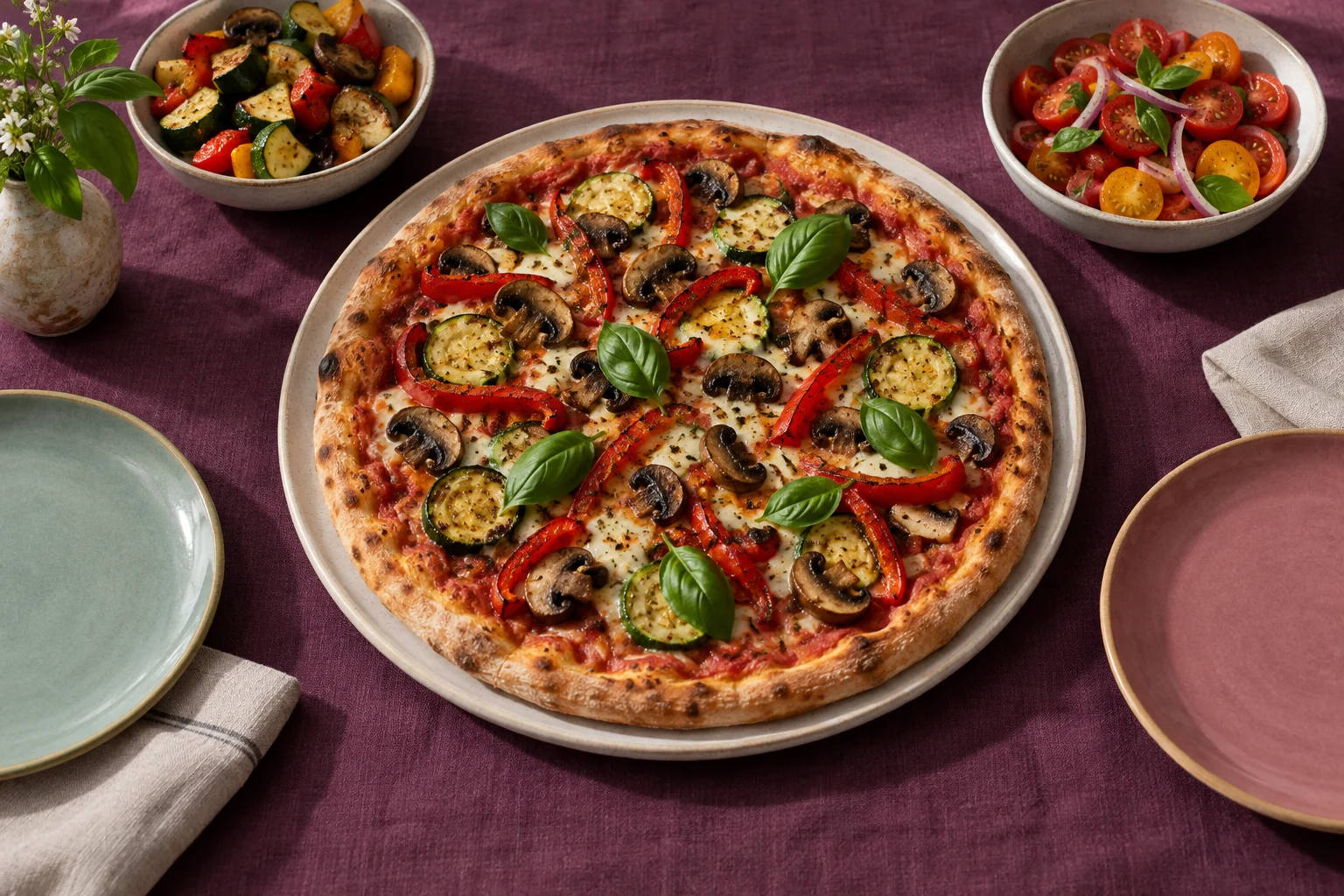
Choose varieties with different characters without creating a completely separate shopping list for each one. For example, a simple tomato pizza with suitable mozzarella could start the meal. A second could combine prepared peppers and courgettes with a restrained amount of cheese. A third might use tomato, olives, capers and fresh herbs without cheese. These are menu suggestions, not fixed recipes or prescribed serving quantities. Let your guests' preferences determine which combinations carry the evening. Three carefully selected varieties can offer more interest than numerous similar pizzas distinguished by one swapped topping. The menu should be easy to understand as well as appealing to eat.
Consider the overall effect of each pizza. A mild base can support one assertive ingredient, while several salty additions may become dominant together. Olives, capers and cheese therefore do not all need to appear generously on the same base. Fresh herbs added after baking create a different accent from cooked vegetables. Texture also adds variety: browned mushrooms, soft peppers and a fresh finishing ingredient produce different impressions. Each combination need not be designed to imitate meat. Vegetables, tomato and cheese can take their own central roles. If you choose an alternative product, judge whether it fits the flavour and baking behaviour of the particular pizza rather than adding it simply because it resembles another food.
Check cheese, sauces and finishing ingredients
For a vegetarian menu, look at the actual cheese you intend to buy. Animal rennet may be used in production. V-Label excludes dairy products made with animal rennet from its vegetarian certification. A suitable explicit product label or clear information from the manufacturer can help you choose. Do not infer suitability solely from the name of a cheese variety. Products differ, and an unclear description remains a question to resolve. For your party, the useful task is selecting appropriate individual ingredients; you do not need to turn that into a universal judgement about every type of cheese or a rule based on its appearance.
Check purchased sauces, pesto and additions used after baking as well. A sauce may contain cheese, and a seasoning may contain ingredients that do not fit the menu. For a plant-based variety, milk and eggs also belong in the ingredient check. Gelatine may matter in an accompanying dessert. A vegetarian or vegan characteristic does not replace allergy information, however. Keep the packaging details for the products used until the party ends so that you can answer specific questions. Additional cheese offered at the table should be separate and clearly identified. This keeps a pizza originally planned without dairy available in that form to the guests who want it.
Prepare vegetables for their actual cooking time
Cut vegetables to suit the pizza style and baking method. A short bake does not cook every vegetable or every thickness equally. Cooking beforehand can help control flavour and moisture, particularly with watery toppings. Mushrooms, for example, can be cooked separately until browned and their excess liquid has evaporated. Peppers or courgettes can be prepared in advance according to the recipe. Thin raw pieces and already tender vegetables do not automatically need identical treatment. What matters is the texture you want and how long the topping will actually spend in the oven. Appropriate cutting is often more useful than adding another ingredient to an already crowded pizza.
Prepare vegetables separately where their cooking times differ. Putting everything into one pan together may leave one ingredient very soft while another is not ready. Allow excess oil or liquid to drain appropriately before topping the pizza. Cooked ingredients intended for later use need prompt, suitable cooling and refrigerated storage. They should not spend hours decorating the table beside the dough. Put smaller amounts into clean bowls for use and replenish from appropriately stored supplies. This keeps the workspace manageable and makes it easier to see how much you are using. Separate preparation also lets you adjust one topping without changing every variety or repeatedly handling ingredients that are already ready.
Consider sauce, cheese and toppings together
A pizza can be too wet or heavily loaded even when each ingredient is good. Tomato sauce, fresh cheese and vegetables contribute moisture together. Applying generous amounts of everything changes the base beneath that weight. Spread sauce according to the recipe and leave visible gaps between larger topping pieces. The unbaked pizza does not need to resemble a filled bowl. A properly baked base contributes to the flavour and should remain part of the finished dish. King Arthur Baking's topping guidance similarly explains that overloading can prevent good browning and leave the bottom soft. Restraint here is about balancing the complete pizza rather than making every ingredient scarce.
Provide small spoons at the topping area and use the first pizza to show what suits your chosen format. This is guidance for your actual bake, not a universal gram allowance for every pizza. Fresh mozzarella benefits from appropriate draining; other cheeses need quantities and preparation suited to their product and recipe. Plant-based alternatives can melt and brown differently. A tomato and vegetable pizza without cheese is also an intentional option, rather than an unfinished substitute. Ask which version guests prefer instead of automatically replacing cheese with the same weight of another product. Flavour and moisture need to work together, and the best choice may differ between two varieties served during the same evening.
Calculate shopping and reserve across the whole menu
Decide the overall pizza quantity first, then divide it between varieties. Do not order each option as though every guest will eat a whole pizza of that variety alone. The amount your group needs depends on size, dough weight, the occasion and other food. Consider a hypothetical division: eight pizzas are planned, with three simple cheese pizzas, three vegetable and cheese pizzas, and two plant-based tomato varieties. That adds up to eight in total, not eight of each kind. If the two plant-based pizzas are intended for particular guests, those guests are already included in the plan and need the corresponding portions kept identifiable.
Calculate ingredients against the pizzas that actually use them. In an assumed quantity example, each pizza receives 60 grams of sauce. Eight pizzas therefore use 480 grams. If cheese is used on only six pizzas in the same example, at an assumed 70 grams each, the cheese total is 420 grams. These are not universal recipe amounts; they illustrate different calculation bases. Any additional reserve should then be included explicitly, rather than quietly added again to each separate ingredient. Pack sizes determine what you buy. They do not mean an entire larger opened pack must be spread over the pizzas simply to avoid having anything left during preparation. Store suitable unused ingredients according to their actual requirements.
Top together and keep baking rounds clear
Set up a clean area with the toppings needed at that point and explain the intended combinations. Guests can make their own adjustments within the selection without bringing every supply to the table. One person manages the oven and coordinates when the next pizza is shaped and topped. This prevents completed pizzas from waiting unnecessarily on the peel. The process depends on your appliance and accessories; paper and mats are not appropriate in every pizza oven. The evening becomes easier when the oven area, topping and serving form recognisable successive tasks. Give hot items a fixed, safe resting place so that a freshly baked pizza never arrives while everyone is searching for a free surface.
Briefly name each new variety and its main ingredients when it arrives. Sharing works well when people understand what they are taking. A personally agreed portion is still best handed to its intended guest. Use clean cutting and serving utensils and account for any actual separation required for allergies; an entirely vegetarian menu does not automatically resolve that issue. Raw dough should not be tasted even without egg, and hands and surfaces need appropriate cleaning after flour and dough work. Children can choose and top at a level suited to their abilities while an appropriate adult handles the hot oven and trays. Participation should remain enjoyable and fit the space available.
Choose sides and dessert to fit the work
A fresh salad or prepared vegetables can complement the pizza without starting a second elaborate cooking process. Select sides that do not need the same oven or worktop at the same moment. If you want warm pasta as well, allow for the pot, sauce, draining and serving. Its quantity also forms part of the complete meal. Several full-sized main courses do not automatically make a better menu. A smaller accompanying dish may provide exactly the contrast you want while keeping pizza central. Consider the length of the evening and whether people will eat together or across several rounds, rather than adding food simply because another recipe looks appealing.
For dessert, choose ingredients that fit the agreed vegetarian or plant-based selection and preparation that fits your refrigeration space. Making something in advance only reduces work during the party if storage and serving are arranged too. You do not need a separate dessert for every pizza variety. A suitable shared option can round off the meal. Keep extras such as nuts, cheese or individual additions clearly separate where they are offered, and respect the agreed requirements. A separate bowl does not automatically make a product suitable for someone with an allergy; its ingredients and handling still matter. Describe only what you can accurately establish from the products used and the preparation actually followed.
Plan suitable leftovers and refine the selection
Before the evening, allow suitable containers and cooling space for appropriate remaining ingredients or dishes. Their actual storage and handling determine whether they can be used later. Unknown standing times cannot reliably be compensated for by reheating. For suitable cooked food in a private household, Germany's BfR recommends prompt cooling, dividing larger quantities among several shallow containers and bringing them below 7 °C within a few hours. The refrigerator should be no warmer than 7 °C, preferably below 5 °C. Do not wait for complete cooling on the worktop before arranging refrigeration. Food already left on guests' plates does not return to the shared supply or its storage containers.
After the party, a short reflection is enough. Which varieties were popular, which ingredient remained, and did the split between cheese and plant-based options suit the group? Adjust those points next time. Your guests may want more simple pizza, fewer choices or a different way of preparing the vegetables. The baking rhythm can also matter more than another new variety. Record combinations that fitted the actual evening without assuming they reveal the preferences of every future guest. You will gradually build a small party repertoire that creates variety from a manageable set of ingredients and gives the next shopping trip a useful starting point. The aim is an enjoyable shared meal that becomes easier to organise.