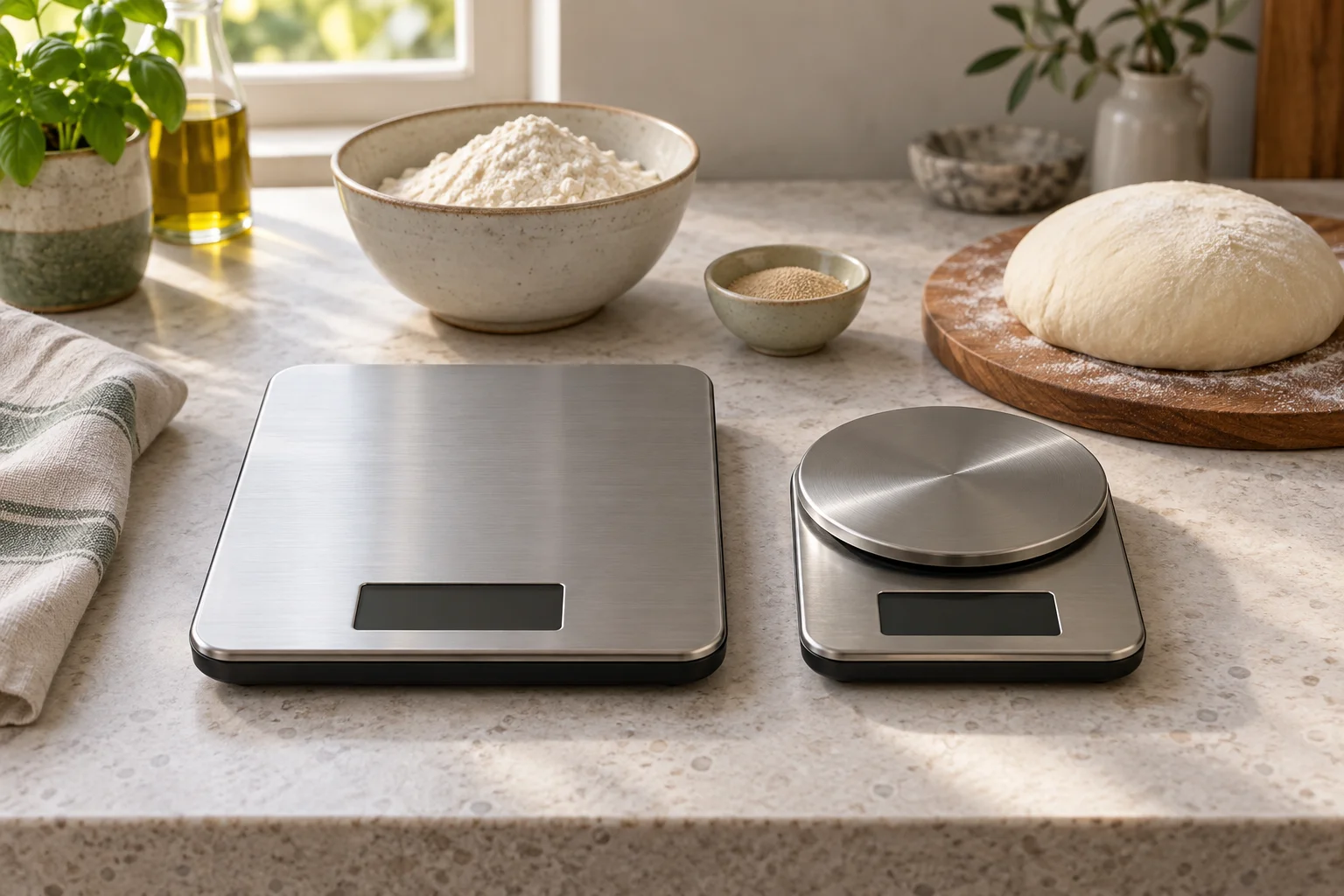
Identify your largest and smallest quantities
Before buying, look at the recipes you actually want to use. Note the largest dough batch you normally prepare and the smallest individual ingredient quantity you need to weigh. There is a considerable difference between a kilogram of flour and 0.3 grams of dry yeast. A scale that supports a full mixing bowl is not automatically suitable for that tiny yeast quantity. Conversely, a precision scale may display small amounts usefully yet become overloaded by a heavy bowl alone. These two requirements are the starting point for selection. The number of decimal places shown in a product photograph only becomes meaningful in that context.
Consider your working method too. Some people weigh every ingredient in a separate container; others add flour and water successively to the same bowl. With the second method, the scale eventually supports the entire mixture. Later, dividing the dough into equal balls is another task that benefits from an accessible, sufficiently large platform. Your existing kitchen scale may already handle these larger jobs well. In that case, add only the missing ability to weigh small quantities. There is no need to replace the whole arrangement if the current device remains suitable and dependable for flour, water and individual portions of dough.
Calculate capacity including the bowl
Maximum load covers everything placed on the scale. An illustrative calculation makes this clear: 1,000 grams of flour, 650 grams of water, 25 grams of salt and 1 gram of yeast total 1,676 grams. If the empty bowl weighs 900 grams, the scale ultimately supports 2,576 grams. A three-kilogram capacity would accommodate this example. These figures do not recommend a particular yeast dose or fermentation time; they demonstrate load calculation only. Whether the ingredient proportions suit your intended dough depends on the complete recipe, including temperature and timing, rather than on the scale you use to weigh them.
Taring does not increase capacity. Although the display shows only the next ingredient after resetting to zero, all the previous weight remains on the sensor. Increase the example batch by a factor of 1.5 and the ingredients total 2,514 grams. With the same bowl, the load becomes 3,414 grams, exceeding the three-kilogram limit. Leave some capacity beyond your normal requirement and place heavy full containers down gently. Check platform dimensions as well: a broad bowl should not obscure the display or rest partly on the counter or another object. If it does, the scale no longer supports and measures its entire load.
Display increments are not measurement accuracy
A one-gram resolution means the display advances in whole grams. A 0.1-gram increment shows tenths; 0.01 grams shows hundredths. This describes how the result is displayed, rather than guaranteeing that it is correct. Whole grams are plainly too coarse for a target quantity of 0.3 grams. However, two decimal places alone still do not prove reliable weighing of a tiny yeast dose. Look for information about the usable measuring range, repeatability and, where supplied, measurement error. If the seller specifies only the smallest display increment, accuracy has not been fully described. Product descriptions do not always make this distinction carefully.
The importance of an error depends on the quantity. As arithmetic alone, an assumed error of 0.02 grams represents approximately 6.7 percent of 0.3 grams, but 0.2 percent of 10 grams. This is not a promised error limit for any particular scale. It explains why very small ingredients deserve attention. The smallest quantity that can be weighed usefully is also not necessarily the first visible display increment. Measurement specialists consider minimum sample weight in relation to the required quality and measurement uncertainty. Pizza dough does not need a laboratory compliance procedure; the useful conclusion is to seek suitability for the actual small amount you need.
One scale, two platforms or an additional device
A larger kitchen scale and a small precision scale divide the work clearly. Flour, water and the full bowl use the larger platform; small ingredients go into a suitable light container on the smaller one. Another option is a device with two separate platforms. Read the specifications for each platform individually. As a concrete manufacturer example, Ooni lists a ten-kilogram maximum in one-gram increments for the large platform of its dual scale, and 200 grams in 0.1-gram increments for the small platform. The finer increment therefore does not apply across the full capacity. These specifications do not establish an overall winner or prove accuracy for every yeast quantity.
Separate devices can be replaced and stored independently, while a combined unit keeps both displays in one place. The more convenient choice depends on your counter and the equipment you already own. Check whether the small platform accommodates the container and whether the reading remains visible while you add ingredients. A light dish is often easier to handle there than a heavy mug. For a recipe requiring very little dry yeast, the smallest suitable sample weight remains the important question. A larger platform or a higher price does not automatically answer it. Choose the missing function rather than selecting simply for the greatest overall capacity.
Use tare to keep each ingredient understandable
Set up the scale according to its instructions, select grams and place the empty container centrally. Wait for a settled reading, then use tare to reset the display to zero. It now shows the added ingredient without the container's weight. If you change containers, establish a new zero for the new starting load. For sensitive small quantities, separate weighing in a light dish can be clearer than adding directly to a large mound of flour. You can see what you have measured and remove an excess before yeast or salt disappears into the other ingredients. This is especially helpful when the intended dose is small.
Weigh ingredients successively in one bowl only when the sequence is clear. After reaching each amount, tare again before adding the next ingredient. Mark the completed quantity in your recipe. If the device switches off midway, do not guess which zero reference still applies. On restarting, a scale may automatically treat the weight already present as its starting point. Recording individual ingredients and the original container weight makes the situation easier to reconstruct. An even simpler approach is to finish weighing small critical amounts separately before adding them to the mixture. That makes an interruption easier to manage without relying on an uncertain remembered display.
Position and handling affect the reading
A level, firm and clean worktop provides a good starting point. The scale should stand on its intended feet, without crumbs beneath them or a soft cloth that changes its support. For small quantities, keep it away from a running mixer and draughts. Movement, air currents and temperature changes can affect measurements, particularly with sensitive instruments. Avoid placing the scale beside a hot oven or putting a hot pan on its platform. After a large temperature change, allow the time specified in its instructions before weighing tiny amounts. An additional decimal place does not compensate for an unsuitable location or an unstable working surface.
As you approach the target, add slowly and allow the display to respond between additions. Do not press on the container, rest a spoon against its rim or let the bowl lean against a wall. A held object can transfer forces to the scale. If a very small addition produces no visible change, do not keep sprinkling indefinitely while expecting an immediate response. First check operation, the model's minimum quantity and its display behaviour. Some devices respond differently to gradual tiny changes and a distinct load placed on the platform. An unclear small measurement calls for a suitable measuring method or device, rather than confidence in an apparently reassuring zero.
Keep grams, millilitres and yeast types distinct
For dough recipes specified in grams, continue weighing in grams. A millilitre mode does not directly measure volume: it converts mass using an assumed density. That conversion does not work indiscriminately for oil, flour or other ingredients. For water near room temperature, grams and millilitres are approximately equivalent, but this does not establish equivalence for all liquids. Following the recipe's gram values avoids an extra conversion. After pressing buttons or replacing batteries, check that the scale still shows the intended unit. A value in ounces can initially resemble a plausible small number of grams, particularly when you are moving quickly between several ingredients.
Even a precisely weighed amount is correct only when it is the right ingredient. Fresh yeast, instant dry yeast and other dried yeast products are not interchangeable merely because their displayed weights match. Use the type specified in the recipe or a justified conversion based on the packaging instructions. Do not estimate a tiny dose using an arbitrary teaspoon: fill level, granule size and spoon shape make that uncertain. If the existing scale cannot measure the required amount usefully, use suitable equipment or a complete dough method with appropriate dosing. Adding more yeast simply to make a number appear changes the formula and can shift the intended fermentation schedule.
Investigate unusual readings without creating a laboratory project
If readings jump unexpectedly, first check the support, clean feet, freely resting bowl, selected unit and battery condition. Repeatedly placing the same unchanged object on the scale can reveal large variation under similar conditions. This is a basic functional observation, not proof of absolute accuracy. A scale can repeat the same incorrect value consistently. Comparing against a known mass requires an appropriate test weight and the manufacturer's instructions. A coin or the nominal contents of an unopened flour bag is not equivalent. Packaging, manufacturing tolerances and actual mass make such household items unsuitable for setting a precise correction to the instrument.
Also distinguish checking from adjustment. Checking compares the displayed reading with a known value; adjustment changes the instrument's setting. Use such a function only as prescribed for the particular model and with the required weight. Not every kitchen scale allows user adjustment. A check at one mass does not prove that every other quantity is measured equally well either. If noticeable discrepancies remain after investigating the simple causes, use the manufacturer's support or a suitable replacement. Trying to compensate in the dough recipe with a succession of invented correction values makes later results difficult to compare and does not establish what was actually weighed.
Cleaning, storage and the buying decision
Keep flour dust, sticky dough and water in the containers wherever possible, rather than allowing them into buttons, gaps or connections. Clean the scale according to its instructions; a wipeable platform does not mean the entire device can go underwater. For its dual-platform scale, Ooni excludes dishwasher use and immersion and describes cleaning the body and display with a dry cloth. Removable dishes may have different care instructions from the electronics. Return a cleaned container to the platform only once its underside is dry. Store the scale without heavy objects pressing continuously on the sensor, and follow battery guidance when leaving it unused for an extended period.
A few concrete points are enough for selection: the total load with your bowl, the smallest ingredient quantity, useful measurement-performance information, a visible display and understandable tare operation. Check the automatic switch-off interval so a longer step does not unexpectedly interrupt weighing, along with power supply and cupboard space. A suitable precision scale can complement an existing kitchen scale. A combined device can provide both functions in one place when both platforms fit the task. The aim is to weigh the quantities in your recipe in a way you can follow and understand. Clear specifications and a simple sequence help more than the largest possible number of decimal places.